History 6 Week 32 Essay

Diocletian 

Diocletian was born in 244 AD to a poor family. He would never have risen to an important position in the government if it wasn’t for his military accomplishments. Little is known about his early life until he joined the military. During his time in the military in the 270’s, Diocletian was a commander in the Balkan Peninsula. He acted as a commander in the guard in 283.  

When Numerian, the previous emperor, was assassinated Diocletian was the first choice as his successor. Diocetian’s reign officially began on November 20, 284 AD. At the time that he assumed the throne Rome had now been in a state of civil unrest for over 50 years. Diocletian knew he could not pull the whole empire together so he divided it into an East and West side. Dioctetian also realized his inability to govern all of Rome  so he split the empire with Maximian. His plan did help to stabilize the empire  but despite his progress the empire still struggled to move forward.

History 6 Week 29 Essay

Hadrian 

Hadrian was born in 76 AD, he became a ward of emperor Trajan when both of his parents died in 86 AD. Trajan did not officially name an heir in public, but his wife claimed that Trajan name as his heir on his deathbed. Hadrian became emperor in 117 and quickly secured the support of the legion and senate. Hadrian ruled 21 years and was very involved in the governing of the empire. Before he became emperor, Hadrian had traveled throughout the empire. He continued this practice during his time as emperor and was outside of Italy for over half of his reign. 

He wanted to straighten the empire through improving the existing core rather than conquering new frontiers. He is considered the third of the 5 good Emperors. His final years were spent in Roam as his health declined, he died in 138 AD.

History 6 Week 28 Essay

Nero 

When Emperor Claudius did not have a suitable heir, he decided to marry his niece, Agrippina and adopt Nero. Nero originally had the name Lucius Domithus, but after Claudius adopted him he changed his name to Nero in 49 AD. Ner became an important public figure at age 14. He married his stepsister in 53 AD. After  Claudius died in 54 AD, Nero became the youngest emperor up to that time. 

For the first few years of his reign, his mother and several of his tutors influenced him. Nero gained control and became the most ruthless ruler. He then killed potential rivals, including his stepbrother and mother. Nero stole authority from the Senate. He made rulings that made the lower class love him, but made the nobility and the Senate angry.  

Nero was mostly peaceful during his reign, once he did dispatch Vespasian to calm a rebellion in the reign of Judah in 67 AD. In 68 AD  Nero commented suicide by having his secretary stab him. His death was mourned by the lower class but celebrated by the nobility and Senate

History 6 Week 25 Essay

The First Punic War

Carthage controlled most of the Mediterranean coasts. Rome’s strength was in the Italian peninsula and its land army. The first Punic war began in 264 BC as a local conflict in Sicily. Two cities on Sicily-Syracuse Messina had a quarrel and started a fight. Messina called on a first carthage and then Rome for aid so the offended Carthaginians then backed Syracuse. 

The fight was no longer about the quarrel between the cities. This was now a fight between Rome and Carthage in contrast to Sicily. War lasted from 264-241 BC and the Romans had only three defeats during that entire time. Carthage had the better navy and Rome knew they could not win in a traditional naval fight. So they invented a new weapon, the assault bridge, and instituted it on their ship. It was a smashing success as the battles could now be fought like land battles even at sea. The battle of Tunis in 255 was the Carthainians’s only major success on land in the first war that caused a break in the war. When Rome regained enough force, it again invaded Sicily and North Africa with great success. Both Rome and Carthage were financially and physically defeated after their 23 years of conflict. However, Rome did prove to be the victor as it developed its navy into a stronger force than the Carhinians at this time, because they won the peace agreement Carthage was required to leave all of Sicily, Return it’s prisoners of war and several smaller island, pay 30 tone of silver immediately and 6.6 tons of annually for 10 years.       

History 6 Week 24 Essay 

When war occurred the citizens were called to the Field Of Mars. The original legion had 4200 soldiers divided into four experienced levels. They had hard training exercises. The discipline was very harsh. If there were any signs of a rebellion they would line the soldiers up, one by one and every 10th man they would kill. Being a Roman soldier wasn’t easy. They had hard training. Soldiers had to buy their own gear and carry it with them to camp. 

The soldier’s javelin had a pointy part on one end, there was a weight on the other end to make it easier to throw. The pointy end was so sharp and fine that after it was thrown that way the enemy couldn’t pick it up and reuse it. 

History 6 Week 23 Review Essay 

Roman Games 

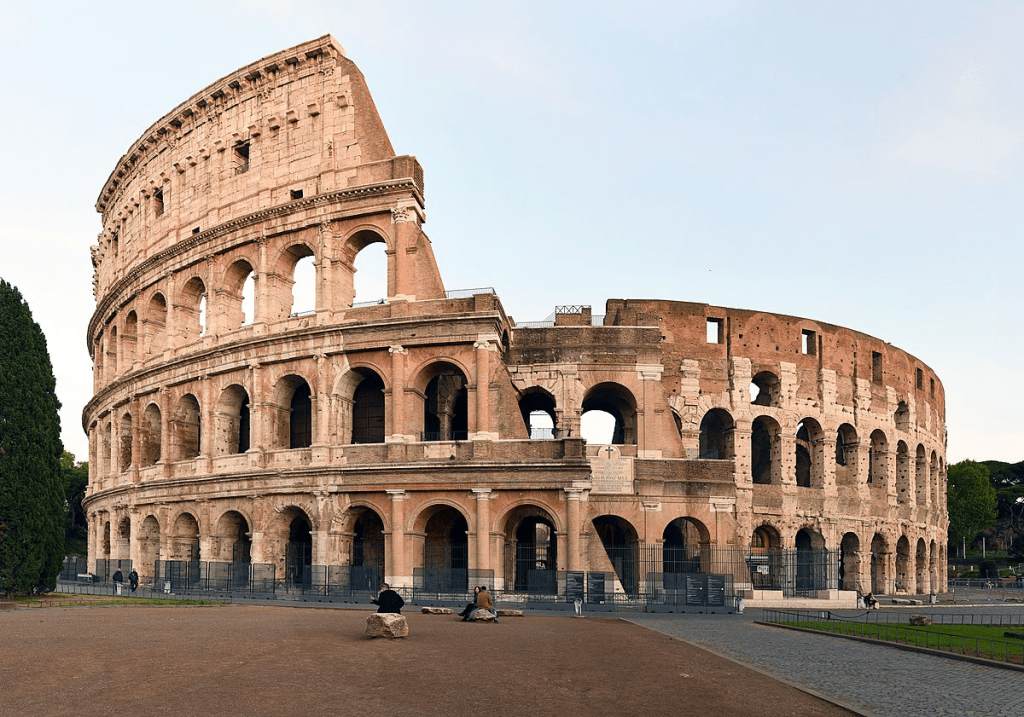
Lucius Tarquinius Priscus was the first king to be a great promoter of the Roman games. He outlined the area that would become the Circus Maximus for the chariot and foot races. Later on the Coliseum and other amphitheaters were built as an arena for watching all of the other games that were held. 

Types of Games 

Morning-

Participants paraded in the amphitheater and animal “hunts” were held. Sometimes animals fought against gladiators other times they devoured defenseless criminals. 

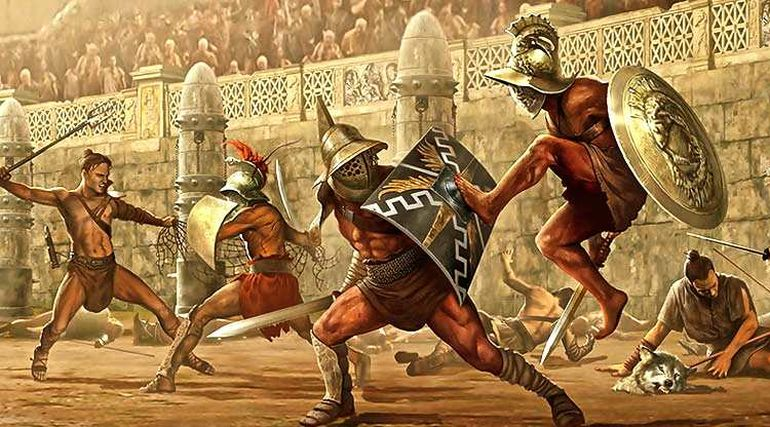
Afternoon- Gladiators fought against each other for the crowd’s entertainment.     

Gladiators

  The gladiatorial fights were the focus of the games. There were at least 25 different varieties of gladiators. Four examples of the most popular are: Semnite, Thracian, Retirius, Murmillo. Most of the Gladiators were slaves or criminal who were forced to fight.

They often fought to the death, but could appeal to the emperor for mercy if they had fought well. Sometimes the amphitheaters were flooded and gladiators fought each other on ships.

Some Pictures of Gladiators

Pictures of the Colosseum

History 6 Week 22 Essay

Kings Of Rome

Romulus The First King Of Rome

Romulus founded Rome in 753. He realized he would need to organize laws and order in Rome. First he organized 12 “lictors” to be his bodyguards. To help grow the city, Romulus, offered residence to any freeman or slave who wanted a new place live.

To maintain order, Romulus also organized the Senate to rule over the people who had joined him.Romulus is greatly remembered for being the founder and the First King of Rome. He organized the first law and order system in Rome. From 753 BC to 509 BC the Senate served the dishes of the king, until the Republic was established.

Numa Pompilius The Second King Of Rome

A year after Romulus there was no king in Rome. The city was ruled by the senate, but the people preferred to be ruled by one man. They decided to leave  the choice to the Senate, they chose Numa Pomilius. Numa was probably one of the best kings that Rome ever had. During all of his reign, he never once was in a war  and he didn’t have enemies.  

Numa made many important changes at the very beginning of his rule. He divided some of the public lands into small farms and gave one of those farmers to every poor Roman. It was hard at first because most of the newbie farmers were soldiers who didn’t have much knowledge on farming. Numa was a very good king, he was friendly with his people and the other countries surrounding Rome. He helped them in times of trouble and wouldn’t listen to any talk of war.

Numa married a woman named Egeria. She lived just outside the wall of Rome, some people thought she was a Goddess or a fairy. Egeria taught  him a lot of the magic that she knew. 

Tullus Hostillus Third King

After the death of Numa the elected Tullus Hostillus, he was more warlike than Romulus. He believed that Rome had grown weak under Numa. The first war he fought against Alba Longa. Each army had a set of triplets. 

Both people of the town were descendants of Aeneas Trogan, because of this it was decided that these brothers should fight as champions. The Hortaill Brothers fought for the Roman side and against them stood the home city of the losing side would be destroyed.  In the battle all three of the Curiatii were wounded and two Hortli were killed. 

The one remaining Hortli was left to fight the three Curiatii. While he was the only one not wounded he couldn’t fight all three of them at once. So he turned and ran. They all ran after him. The first brother was only slightly wounded and he was able to keep up, while the second brother was more severely wounded and the third completely fell behind. Once Hortli had all the brothers spread out, he turned and killed the first brother he moved on to kill the second, then to the third. Hortli claimed that he killed the first two brothers to avenge his, then he would kill the third for Rome. 

Alba Lounga was now under Rome’s rule, the people were very upset. King Mettius talked about regaining their freedom through nefarious means. They encouraged the nearby town of Veii to attack Rome. Hinting that they would betray their supposed allies in battle. 

But during the battle Mettius wasn’t brave enough to betray the Romans or help them. So they retreated to a hillside to see who won. 

Rome won, and Mettius and his army came down to congratulate Hostilis on his win. Hostilis wasn’t stupid. So to prevent any more disloyalty to him and Rome he made the people of Alba Longa move to Rome and join its people. He had a terrible punishment for Mettis. 

His mind was divided between Rome and Veii and now his body would also be divided. His legs were tied to two four horse chariots then subsequently his body ripped apart.  

A meteor shower struck Rome not long after a plague also hit Rome. Everyone blamed Hostilis for focussing more on war than worshiping the gods. He didn’t believe it until he got the plague himself. He brought out all the religion manuals of Numa. 

While performing a secret ritual to Jupiter he made a mistake, out of anger Jupiter struck him down with a thunderbolt.

History 6 Week 19 Essay

There was an 180 day long festival that King Ahasuerus held before invading Greece, during that time he got very drunk. He summoned his wife Vashti, so he could show off how beautiful she was. She refused to come and in turn she lost her position as queen.  

When Ahasuerus returned from Greece he chose another queen. A young Jewish girl named Esther was raised by her cousin, Mordecai. But she kept the fact that she was a Jew a secret.

Haman was an Agagite and he hated the Jews. He hated them so much that he went to the king and asked him to make a decree that all the Persians should kill the Jews. Expect he didn’t tell him that he wanted the Jews killed. Mordecai told Esther of Haman’s plans, he told her to go to the king and ask him to take back that decree. She agreed and went to the king, after telling him what Haman was planning to do. Ahasuerus was furious, he hung Haman and made a new decree that the Jews were allowed to fight back the day they were supposed to be killed.  

After all of these events there was a feast that was held named Purim.

History 6 Lesson 16 Essay 

Pandora’s Box 

Pandora was the wife of a man named Epimetheus. She was a gift from the gods, his brother, Prometheus told him not to expect any gifts from the gods. But he didn’t listen to him and married Pandora.

Zeus The God of the Sky and Thunder gave Pandora a beautiful box on her wedding day. There was only one condition, she could never open the box. Pandora couldn’t understand why she was given the box if she wasn’t allowed to see what was inside it. 

Thought’s of opening the box consumed her, finally she couldn’t take it anymore. So when her husband was out of sight, she snuck into the room where the box was. Taking the key off of the wall she unlocked the box, but at the last minute she felt guilty and knew how mad her husband would be if she opened it, so she locked it back and put the key back where she found it. She did this three more times, unlocking it then locking it back and putting the key away. The thoughts of opening the box still consumed her. She couldn’t take it anymore, she thought she would go mad if she didn’t see what was in the box. 

She took the key and unlocked the box, expecting to find a teacher or beautiful dresses. But she found none of that stuff, instead she found all of the horrible evils that Zeus would think of and put them into that box. Disease, poverty,misery, death, and sadness all came out of the box shaped like tiny buzzing moths. They all stung Pandora over and over again, she slammed the lid of the box shut, Epimetheus came running into the room to see why she was crying. Pandora could hear a voice calling to her from the box, asking to be let out. Epimetheus agreed that there wasn’t anything else inside the box other than the horrors that had already been released. So they opened the box again. Out of the box spring Hope in the form of a dragonfly, it touched the wound made by the evil creatures. Even though Pandora had realized Pain and suffering upon the world she also released Hope to follow them. 

History 6 Week 2 Review Essay

My favorite place in the world was Ancient Greek. I know I’ve said this before but I’ll say it again. Ever since Percy Jackson I’ve been really interested in Greek and Roman Mythology, and for some reason I’ve also been interested in Egyptian Mythology. I haven’t read any books that got me interested in it but I do have a book called The Kane Chronicles by Rick Rioran. Who is the author of the Percy Jackson series.  Anyway, back on track, if I don’t get back on track then I’ll end up talking about books. My point was it was interesting because my teacher talked about a story that I read in English. It was really interesting to hear that story again. Not gonna lie I forgot most of it because of the other stories I read. But I would one day really like to just learn as much as I can about Greek Mythology.